Digital platform ROYC: New entrants to the market are driving cost inflation
Faced with an ongoing fundraising drought, private equity managers are increasingly eyeing a broader range of investors. A new breed of alternative investment platform is opening up that opportunity for wealth managers and banks.
When Private Equity International caught up with London- and Stockholm-headquartered digital wealth platform ROYC last year, it was gearing up to roll out evergreen structures. One year later and the firm has announced partnerships with the Riverside Company, Ardian and Partners Financial Group, among others, for cross-European private wealth distribution. It has also built out its GP solutions business, which provides bespoke digital LP management and fund structuring.
"We launched the B2B platform in January 2024, and it’s been a very rapid development since,” Mathias Leijon, co-founder and president of ROYC, told PEI this month. “We started by onboarding a lot of distribution partners – essentially multifamily offices, wealth managers and independent financial advisers. That gave us the opportunity to pressure test the platform, optimise features and continue building on functionalities… then gradually develop our GP solutions."
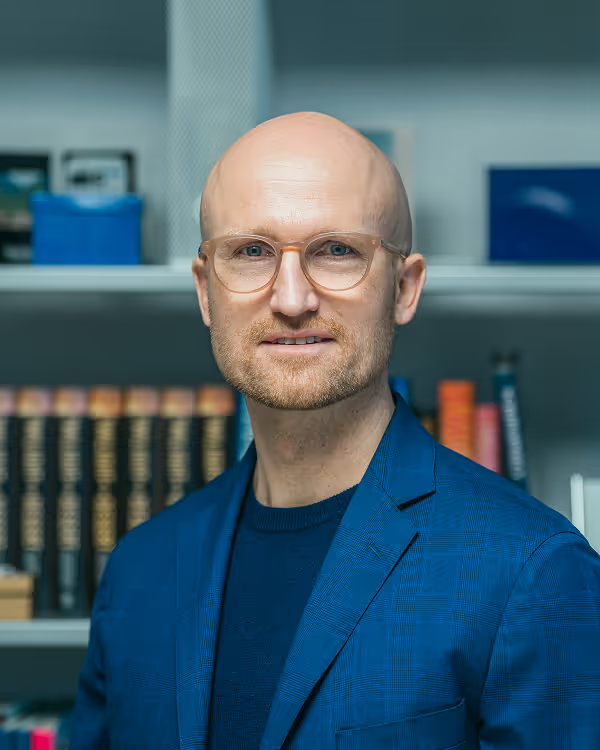
ROYC, which stands for ‘return on your capital’, was founded in 2022 by former Blackstone managing directors Octavian Popescu and Oscar von Reis, and Leijon, who was previously at Nordea. The B2B white-label operating system offers clients features including fundraising analytics, LP lifecycle management and operational infrastructure.
Leijon noted that ROYC essentially allows a GP or bank to focus on two things: ensuring they provide clients with the best opportunities, and driving AUM.
“Everyone wants to grow AUM. Our role is, besides delivering cost efficiency, to help them with the data and analytics to allow them to sell more. The pain points we are solving are the manual processes and the poor LP experience, and generally reducing built-in complexities which [drive the costs].” “We are supporting, from a client perspective, large GPs wanting a private wealth platform, locally domiciled GPs wanting a Lux structure, or US/Asia-based GPs that want a solution for Europe. We do the structuring of these feeder funds, which is seamlessly connected to our operating platform, essentially optimising the entire fund lifecycle.”
More LPs entering private markets means more operational complexity for everyone in the ecosystem, according to Leijon.
“The number of capital allocators, new strategies, products and vehicles all result – as a result of the analogue delivery models – in a cost inflation that becomes too high for the ecosystem to sustain in a profitable way,” he said. “This is why we say that fund structuring and fund operations has moved to the C-suite-level conversation. How firms approach fund structuring, fund formation, the operating model and the operational support platform has become strategic.”
ROYC has technology at its core, and the operating system rolls out at least two new features every week, according to Leijon. Before launching ROYC, its team of at least 15 in-house software engineers had pressure tested the tech infrastructure by having iterative and interactive sessions with 13 different wealth managers, banks and renowned GPs for more than seven months.
“Before we even wrote a single line of code, we got to figure out the real and core problems clients wanted us to solve. That has served us very well and enabled us to build a solution that caters to both the updated security needs of clients and the full range of products such as closed-end funds, semi-liquid funds and UCI II funds, among others,” Leijon said.
What’s next for ROYC? It’s all about scaling across tech, operations and sales, according to Leijon. He noted that the platform is backed by well-capitalised, long-term owners including European family offices, industry professionals and senior partners from blue-chip GPs.
“At ROYC, we want to contribute to streamlining the operational lifecycle management, which would allow for this overall asset class to grow. Of course, we need to do this together with others – that is what we aspire to do.”